

Ligneous Lightning | Seeing Trees from a Different Perspective


When I picked up a camera for the first time, I was immediately drawn to exploring the starkness of dead trees against vast backgrounds. Over the intervening six years of my development as a photographer, I’ve shifted from these longshot compositions to compositions that delve into granular patterns I spy in tree branches. While shooting from this perspective certainly highlights the fractal abstractness of these patterns, as I’ve become more focused on them, I’ve realized that the patterns themselves aren’t unique to just trees. Like most fractals, the small universes within each grouping of tree branches seemingly resemble much larger patterns that appear in other places. If I’m being honest, though, it took me a while to notice.
It’s funny how things come to you. For the longest time, I was comfortable thinking the silhouettes of branches I was photographing against either super colorful backgrounds or, when in black and white, blinding nothingness were just interesting compositions pleasing to the eye. Puzzles, if you will, highlighted by bursts of brightness and color, to be solved or admired. As time has gone on, I’ve become increasingly obsessed with the subject matter, often getting strange looks from people to whom I tell “I like to photograph tree branches.” It doesn’t help matters that, typically, there are only a few months annually where I can even capture the effect thanks to the heavy foliage that permeates Georgia most of the year. Some people are tormented by fumbled opportunities, lost loves, addiction…my torment lay in the question: “What is it about tree branches?” As luck would have it, the Universe used the same Georgia weather that limits my access to them to answer the question.
Georgia lays within a geographic region sometimes referred to as Dixie Alley. Dixie Alley stretches from east Texas to western North Carolina and is so named because, like its more well-known counterpart, Tornado Alley, it’s prone to high-volume tornadic activity, particularly in the early part of the year. One night a few weeks ago, one of these violent storm cells blew through in the early morning, and while it didn’t produce any tornados, it did produce a ton of lightning. As I lay awake in bed, listening to the wind and thunder, pondering the meaning of life, a sudden flash of lightning came through the window I was blankly staring out of and, presto, long-standing-photographic-obsession-question answered. My tree branches look like bolts of lightning. I now refer to this effect as “ligneous lightning” (ligneous for wood, lightning for, well, lightning). For what’s it’s worth, sometimes these photo compositions also look kind of like river deltas (see pic later on of the Mississippi River Delta), but I’m putting my money on the long-term subliminal impact of lightning bolts as it relates to my eye for spotting patterns in tree branches.

The beauty of this juxtaposition taps into various interpretations of the classic philosophical concept of “As Above, So Below”, a concept that speaks to the recognition or acknowledgement that the larger universe is often reflected by the smaller universe. In this case, bolts of lightning that illuminate the sky for miles across wide swaths of landscape are microcosmically reflected in something like my granular images of tree branches. This juxtaposition also often has an eerie polarity of equal measure (see photo collections further down), enhancing the mirror-like relationship the lightning has with the trees. If you add to all of this lightning’s proclivity for striking trees - the macrocosmic actually touching the microcosmic…well, that element is a topic perhaps best left for another essay in the future. Regardless of additional, expansive questions about the inner workings of the Universe, the resemblance of my tree branch photographs to lightning is uncanny. To think I’ve been channeling my skills to capture these effects due to some sort of subliminal impression is the kind of thing that will no doubt keep me up at night the next time a storm wakes me.
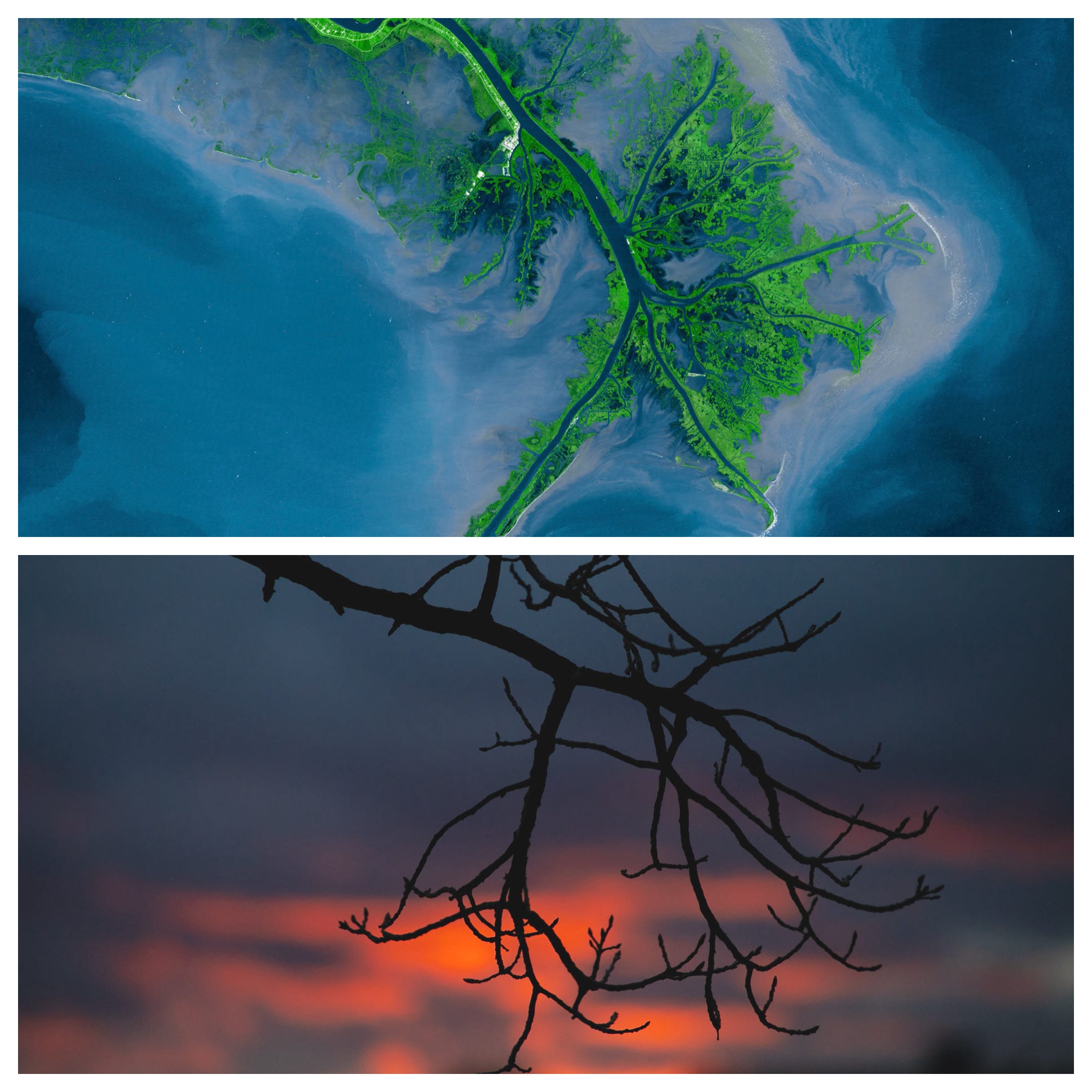
In a twist, even the act of photographing spartan tree branches is a polarized version of shooting lightning storms. For one it’s a lot safer. It’s also deliberate, methodical and manual, whereas contemporary lightning photography involves chance and sophisticated equipment like lightning triggers. I’ve attempted to spontaneously photograph lightning before, without a trigger, and it’s next to impossible. Your brain simply cannot send the message to your shutter finger fast enough to get anything great, which leaves one to a lot of anticipatory guesses with the shutter set on burst mode, an approach I would categorize as “low-percentage-for-success”.


There are so many fascinating things that compose the world around us hiding in plain sight. In that respect, I’d like to think I treat photography more as an exercise in discovery rather than art, though I concede the creative drive to make art of any kind is itself a purely meditative exercise in discovery. What are you capable of contemplating? How can you best convey a feeling through a single image? Where do you go to find it? Six years in, this journey of discovery has revealed so many places, so many conditions (both human and environmental), and so many different ways of “seeing” the same sort of objects over and over. The more discovery I journey toward, the more truths I stumble on. The photographs are merely artifacts of that journey.


For more about all my photography and other art projects, please visit Fenwick Designs.